What’s Hot

Showing posts with label respiratory therapist. Show all posts
Develop a Written Asthma Management Plan
As part of the overall management of patients with asthma, the health-care provider, in consultation with the patient or the parent or guardian of a child with asthma, should develop a written plan as part of educating patients regarding self management, especially for patients with moderate or severe persistent asthma and those with a history of severe exacerbation.
The National Heart, Lung, and Blood Institute provides more specific advice on asthma management plans, emphasizing the provider/patient partnership (available at http://www.
nhlbi.nih.gov/health/public/lung/asthma/asthma.htm#plan).
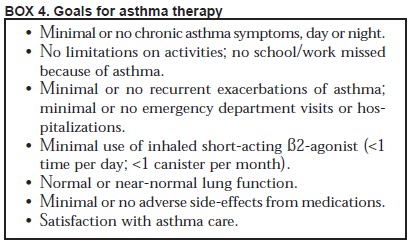
Writing the management plan helps clarify expectations for treatment (Box 4) and provides patients with an easy reference for remembering how to manage their asthma. The action plan should include written instructions on recognizing symptoms and signs of worsening asthma; taking appropriate medicines (type, dose, and frequency); recognizing when to seek medical care; and monitoring response to medications.
Symptom-based plans may be equally effective as plans based
on peak flow monitoring, although some patient preferences and circumstances (e.g., inability to recognize or report signs and symptoms of worsening asthma) may warrant a choice of peak flow monitoring. The management plan should be reviewed and adjusted, as needed, at every visit. For children, a copy of the plan should be given to each care giver and the child’s school.
Develop a Written Asthma Management Plan

Develop a Written Asthma Management Plan

Develop a Written Asthma Management Plan
As part of the overall management of patients with asthma, the health-care provider, in consultation with the patient or the parent or guardian of a child with asthma, should develop a written plan as part of educating patients regarding self management, especially for patients with moderate or severe persistent asthma and those with a history of severe exacerbation.
The National Heart, Lung, and Blood Institute provides more specific advice on asthma management plans, emphasizing the provider/patient partnership (available at http://www.
nhlbi.nih.gov/health/public/lung/asthma/asthma.htm#plan).
Writing the management plan helps clarify expectations for treatment (Box 4) and provides patients with an easy reference for remembering how to manage their asthma. The action plan should include written instructions on recognizing symptoms and signs of worsening asthma; taking appropriate medicines (type, dose, and frequency); recognizing when to seek medical care; and monitoring response to medications.
Symptom-based plans may be equally effective as plans based
on peak flow monitoring, although some patient preferences and circumstances (e.g., inability to recognize or report signs and symptoms of worsening asthma) may warrant a choice of peak flow monitoring. The management plan should be reviewed and adjusted, as needed, at every visit. For children, a copy of the plan should be given to each care giver and the child’s school.
Develop a Written Asthma Management Plan


Classify Severity of Asthma
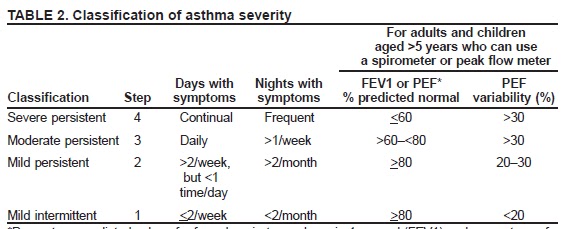
Because asthma is characterized by varying signs and symptoms, for appropriate treatment and monitoring, the severity of such signs and symptoms must be classified at the initial and all subsequent visits. Initially and before treatment has been optimized, clinical signs, symptoms, and peak flow monitoring or spirometry are used to classify severity (Table 2)
(Box 2). After the patient’s asthma is stable, severity is subsequently classified according to the level of medication required to maintain treatment goals.
Health-care providers should have the knowledge, equipment, staff or access to needed resources to aid in classification and proper management of all patients with asthma.
Classify Severity of Asthma

Classify Severity of Asthma

Classify Severity of Asthma
Because asthma is characterized by varying signs and symptoms, for appropriate treatment and monitoring, the severity of such signs and symptoms must be classified at the initial and all subsequent visits. Initially and before treatment has been optimized, clinical signs, symptoms, and peak flow monitoring or spirometry are used to classify severity (Table 2)
(Box 2). After the patient’s asthma is stable, severity is subsequently classified according to the level of medication required to maintain treatment goals.
Health-care providers should have the knowledge, equipment, staff or access to needed resources to aid in classification and proper management of all patients with asthma.
Classify Severity of Asthma

How are Environmental Factors Linked to Asthma? (Lucas Neas - ORD)
Genetic factors, viral and parasitic infections, diet, lifestyle, air pollution, and allergen sensitization are all linked in some way to asthma. However, none of them alone can be considered the source of the recent upward trend in asthma cases. While genetics are certainly a factor, they do not change quickly enough for a genetic shift to be the cause of the trend. However, genetic factors predispose people to asthma, who are then forced over to active asthma by an increasingly “adverse” environment.
The decrease in infections, due to vaccination and smaller families, means that there has been an overall decrease in the necessity for an immune response to certain diseases. This may sensitize the body to asthma-related allergens. However, this decrease has occurred since the 1960s while the asthma trend is more recent. With regard to diet, it has been found that antioxidants are more protective and an increase in trans-fatty acids, salt, and sugar in the diet due to junk food may be a risk factor. There has certainly been an increase in the consumption of junk food in the United States since the 1960s, but there is a question as to whether this would explain the worldwide trends. The levels of exposures due to indoor and outdoor antigens may have increased, including on an occupational and even community-wide level. Early childhood exposures to dust mites, humidified homes, cockroaches, cat dander, mold spores, and pollen may have increased. However, this does not explain why asthma incidence seems to increase after moving from an urban poor environment to a rich environment. This phenomenon has been seen in Ghana. Other research has looked at lifestyle causes, such as the lack of general time outdoors, particularly spent engaging in vigorous activity. Data have shown that living on a farm provides protection from asthma; this may mean that today’s children spend too much time on indoor activities which increases their exposure to indoor pollutants over time. In addition, pulmonary “exercise” results from general time outdoors. However, if outdoor activity is promoted, it is necessary to ensure that the ambient environment is not polluted.
Air pollutants have been considered as asthma triggers. However, air pollution has decreased over the past decade while asthma cases and severity have increased. For example, the dramatically cleaner air that resulted from the shutdown of many plants in the former East Germany did not result in changes of asthma rates. In fact, while eastern Germany has more bronchitis and wheeze associated with airborne irritants, they also experience lower rates of asthma and hay fever than in western Germany. In addition, New South Wales, Australia has high rates of asthma but a clean environment.
The Harvard Six-Cities Study and 24-City Study in the United States and Canada looked at the prevalence of respiratory illness in children vs. air pollution. Bronchitis was associated with air pollutants but asthma was not. A study performed in Kanawha County, West Virginia showed an association between volatile organic compounds (VOCs) and other traffic-related pollution and asthma on a city-wide scale.
Based on these studies, it appears that air pollutants may play a greater role as a trigger or exacerbation of asthma but not as a cause, although they may increase the possibility of sensitization to antigens and bioaerosols. Air toxics, such as those associated with traffic, present an area needing further study.

Environmental Factors Linked to Asthma

How are Environmental Factors Linked to Asthma

How are Environmental Factors Linked to Asthma? (Lucas Neas - ORD)
Genetic factors, viral and parasitic infections, diet, lifestyle, air pollution, and allergen sensitization are all linked in some way to asthma. However, none of them alone can be considered the source of the recent upward trend in asthma cases. While genetics are certainly a factor, they do not change quickly enough for a genetic shift to be the cause of the trend. However, genetic factors predispose people to asthma, who are then forced over to active asthma by an increasingly “adverse” environment.
The decrease in infections, due to vaccination and smaller families, means that there has been an overall decrease in the necessity for an immune response to certain diseases. This may sensitize the body to asthma-related allergens. However, this decrease has occurred since the 1960s while the asthma trend is more recent. With regard to diet, it has been found that antioxidants are more protective and an increase in trans-fatty acids, salt, and sugar in the diet due to junk food may be a risk factor. There has certainly been an increase in the consumption of junk food in the United States since the 1960s, but there is a question as to whether this would explain the worldwide trends. The levels of exposures due to indoor and outdoor antigens may have increased, including on an occupational and even community-wide level. Early childhood exposures to dust mites, humidified homes, cockroaches, cat dander, mold spores, and pollen may have increased. However, this does not explain why asthma incidence seems to increase after moving from an urban poor environment to a rich environment. This phenomenon has been seen in Ghana. Other research has looked at lifestyle causes, such as the lack of general time outdoors, particularly spent engaging in vigorous activity. Data have shown that living on a farm provides protection from asthma; this may mean that today’s children spend too much time on indoor activities which increases their exposure to indoor pollutants over time. In addition, pulmonary “exercise” results from general time outdoors. However, if outdoor activity is promoted, it is necessary to ensure that the ambient environment is not polluted.
Air pollutants have been considered as asthma triggers. However, air pollution has decreased over the past decade while asthma cases and severity have increased. For example, the dramatically cleaner air that resulted from the shutdown of many plants in the former East Germany did not result in changes of asthma rates. In fact, while eastern Germany has more bronchitis and wheeze associated with airborne irritants, they also experience lower rates of asthma and hay fever than in western Germany. In addition, New South Wales, Australia has high rates of asthma but a clean environment.
The Harvard Six-Cities Study and 24-City Study in the United States and Canada looked at the prevalence of respiratory illness in children vs. air pollution. Bronchitis was associated with air pollutants but asthma was not. A study performed in Kanawha County, West Virginia showed an association between volatile organic compounds (VOCs) and other traffic-related pollution and asthma on a city-wide scale.
Based on these studies, it appears that air pollutants may play a greater role as a trigger or exacerbation of asthma but not as a cause, although they may increase the possibility of sensitization to antigens and bioaerosols. Air toxics, such as those associated with traffic, present an area needing further study.

Environmental Factors Linked to Asthma

What are the Basic Aspects of Asthma? (Hillel Koren - ORD)
There are almost 15 million asthmatics in the United States, resulting in 15.5 million outpatient visits and 415,000 hospitalizations per year. Approximately 5,000 people in the United States die each year from an asthma attack. Asthma also causes a significant economic impact, not only from the direct health care costs associated with treatment but also substantial indirect costs, such as absenteeism from work and lost productivity. The incidence and severity of asthma is increasing worldwide, despite the fact that ambient air pollution levels have dropped over the past ten years. This increase has occurred disproportionately among African Americans and other minorities in the United States. Poverty has been suggested as the reason for this; however, asthma is relatively lower in Africa, where poverty is quite high. It has also been considered that the answer lies in lifestyle changes, where changing to a less “traditional,” more Western lifestyle marks an increase in asthma incidence. In Australia, however, higher rates of asthma are found in the rural, rather than the urban, parts of the country. These examples illustrate the complexity of the asthma issue.
Asthma is a complex, multi-factorial disease characterized by reversible airway obstruction, non-specific airway hyperresponsiveness, and mucus hypersecretion; it is a chronic airway inflammatory disease with episodes of acute exacerbation. A complex network of immune cells, effector cells, cytokines, and other mediators interact to produce the asthmatic response. Asthma can vary widely in severity, both between and within individuals, but common symptoms include wheezing, shortness of breath, cough, chest tightness, and mucus production. Typical features of asthma include an increased level of immunoglobulin E, a positive reaction to inhaled allergens, and exaggerated bronchoconstriction in response to airway cooling or drying, exercise, and chemical or pharmacologic bronchoconstrictors (e.g., histamine or methacholine). The disease can be divided into two general categories, e.g., extrinsic and intrinsic. Extrinsic allergic asthma involves hereditary factors and allergens and is detected by the presence of serum IgE. Most childhood asthma falls into this category. Intrinsic asthma, which is more common in adults, does not involve these factors but results in similar pathobiology and treatment as extrinsic asthma.
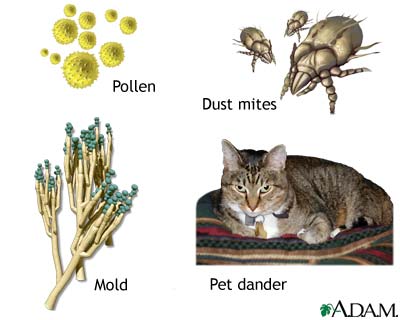
Asthma is triggered by many factors in the environment, including house dust, pet dander, fungi, and cold air. Food allergens and stress can also trigger the condition. Genetic risk factors play a significant role in determining which people show signs of asthma, given similar exposure scenarios. The presence of atopy is a risk factor for developing overt asthma. If one parent is atopic, half of the children will have atopy. If both parents are atopic, 75 percent of the children will have atopy. If neither parent is atopic, there is a 15 percent chance of having an atopic child, which means that the potential for asthma exists. While there is certainly genetic control of asthma, there is no single gene responsible for its expression. The interaction between the environmental and genetic risk factors results in clinical asthma and the pathologic abnormalities of asthma, including bronchospasms, mucosal edema, airway inflammation, increased mucosal secretion, and a thickening of the basement membrane. While a normal airway has a well-organized epithelium, an asthmatic airway has a disrupted epithelium, is constricted, has a mucus hypersecretion plug, enlarged smooth muscle cells, and an inflamed basement membrane.
During the first hour after asthma attack, there is an initial drop in lung function and then an oscillation in function which decreases in a few days. Repeated episodes of airway inflammation can cause long-term structural damage and weakness, making the airways more prone to damage during the next attack. For this reason, it is important to control asthma so that the condition does not worsen.
Airways hyperresponsiveness alone is not necessarily diagnostic of asthma. Airway inflammatory cells in asthmatics characteristically include eosinophils, other polymorphonuclear granulocytes, and lymphocytes. Injury of the airway epithelium is present to varying extents, even in individuals with mild asthma. Evaluation of a patient with suspected asthma includes family, exposure, and social history. Tests for IgE antibody, pulmonary function, and allergy skin tests are conducted. The severity of asthma is different for any asthmatic and can range from mild, moderate, to severe persistent asthma, depending on the degree of exacerbation, activity levels, and compromise of pulmonary function (peak air flow).
The management and treatment of asthma involves working with the patient to develop treatment goals and an action strategy. Goals might be to prevent chronic and troublesome symptoms, prevent acute attacks, and continue all activities. The patient is provided with written, individualized instructions, a daily plan for management, and the long-term benefits of following the plan are discussed. The patient is taught how and when to use the peak lung flow meter, which can predict some asthma attacks. Medications are also helpful for control and include a regime of beta-agonist inhalers and steroids.
Poor disease management, lack of accessibility to medical services, inadequate advanced planning, and lack of outdoor exercise may contribute to the increased incidence and severity of asthma. In addition, it is possible that the decreased prevalence of infectious diseases has had an affect on the immune system, enhancing the response to allergens. ETS and other indoor air quality issues may also play a role. In summary, asthma appears to be a disease of modern, industrialized, affluent societies.
the Basic Aspects of Asthma

the Basic Aspects of Asthma

What are the Basic Aspects of Asthma? (Hillel Koren - ORD)
There are almost 15 million asthmatics in the United States, resulting in 15.5 million outpatient visits and 415,000 hospitalizations per year. Approximately 5,000 people in the United States die each year from an asthma attack. Asthma also causes a significant economic impact, not only from the direct health care costs associated with treatment but also substantial indirect costs, such as absenteeism from work and lost productivity. The incidence and severity of asthma is increasing worldwide, despite the fact that ambient air pollution levels have dropped over the past ten years. This increase has occurred disproportionately among African Americans and other minorities in the United States. Poverty has been suggested as the reason for this; however, asthma is relatively lower in Africa, where poverty is quite high. It has also been considered that the answer lies in lifestyle changes, where changing to a less “traditional,” more Western lifestyle marks an increase in asthma incidence. In Australia, however, higher rates of asthma are found in the rural, rather than the urban, parts of the country. These examples illustrate the complexity of the asthma issue.
Asthma is a complex, multi-factorial disease characterized by reversible airway obstruction, non-specific airway hyperresponsiveness, and mucus hypersecretion; it is a chronic airway inflammatory disease with episodes of acute exacerbation. A complex network of immune cells, effector cells, cytokines, and other mediators interact to produce the asthmatic response. Asthma can vary widely in severity, both between and within individuals, but common symptoms include wheezing, shortness of breath, cough, chest tightness, and mucus production. Typical features of asthma include an increased level of immunoglobulin E, a positive reaction to inhaled allergens, and exaggerated bronchoconstriction in response to airway cooling or drying, exercise, and chemical or pharmacologic bronchoconstrictors (e.g., histamine or methacholine). The disease can be divided into two general categories, e.g., extrinsic and intrinsic. Extrinsic allergic asthma involves hereditary factors and allergens and is detected by the presence of serum IgE. Most childhood asthma falls into this category. Intrinsic asthma, which is more common in adults, does not involve these factors but results in similar pathobiology and treatment as extrinsic asthma.
Asthma is triggered by many factors in the environment, including house dust, pet dander, fungi, and cold air. Food allergens and stress can also trigger the condition. Genetic risk factors play a significant role in determining which people show signs of asthma, given similar exposure scenarios. The presence of atopy is a risk factor for developing overt asthma. If one parent is atopic, half of the children will have atopy. If both parents are atopic, 75 percent of the children will have atopy. If neither parent is atopic, there is a 15 percent chance of having an atopic child, which means that the potential for asthma exists. While there is certainly genetic control of asthma, there is no single gene responsible for its expression. The interaction between the environmental and genetic risk factors results in clinical asthma and the pathologic abnormalities of asthma, including bronchospasms, mucosal edema, airway inflammation, increased mucosal secretion, and a thickening of the basement membrane. While a normal airway has a well-organized epithelium, an asthmatic airway has a disrupted epithelium, is constricted, has a mucus hypersecretion plug, enlarged smooth muscle cells, and an inflamed basement membrane.
During the first hour after asthma attack, there is an initial drop in lung function and then an oscillation in function which decreases in a few days. Repeated episodes of airway inflammation can cause long-term structural damage and weakness, making the airways more prone to damage during the next attack. For this reason, it is important to control asthma so that the condition does not worsen.
Airways hyperresponsiveness alone is not necessarily diagnostic of asthma. Airway inflammatory cells in asthmatics characteristically include eosinophils, other polymorphonuclear granulocytes, and lymphocytes. Injury of the airway epithelium is present to varying extents, even in individuals with mild asthma. Evaluation of a patient with suspected asthma includes family, exposure, and social history. Tests for IgE antibody, pulmonary function, and allergy skin tests are conducted. The severity of asthma is different for any asthmatic and can range from mild, moderate, to severe persistent asthma, depending on the degree of exacerbation, activity levels, and compromise of pulmonary function (peak air flow).
The management and treatment of asthma involves working with the patient to develop treatment goals and an action strategy. Goals might be to prevent chronic and troublesome symptoms, prevent acute attacks, and continue all activities. The patient is provided with written, individualized instructions, a daily plan for management, and the long-term benefits of following the plan are discussed. The patient is taught how and when to use the peak lung flow meter, which can predict some asthma attacks. Medications are also helpful for control and include a regime of beta-agonist inhalers and steroids.
Poor disease management, lack of accessibility to medical services, inadequate advanced planning, and lack of outdoor exercise may contribute to the increased incidence and severity of asthma. In addition, it is possible that the decreased prevalence of infectious diseases has had an affect on the immune system, enhancing the response to allergens. ETS and other indoor air quality issues may also play a role. In summary, asthma appears to be a disease of modern, industrialized, affluent societies.
the Basic Aspects of Asthma